Memory Training
Strengthen short-term and working memory with fun visualization games.
Key Benefits
- Improves concentration
- Enhances visual recall
- Develops focus
Why it matters
Working memory is critical for following multi-step instructions and mental math.
🗺️ Curriculum Roadmap
🎮 Games that build this skill
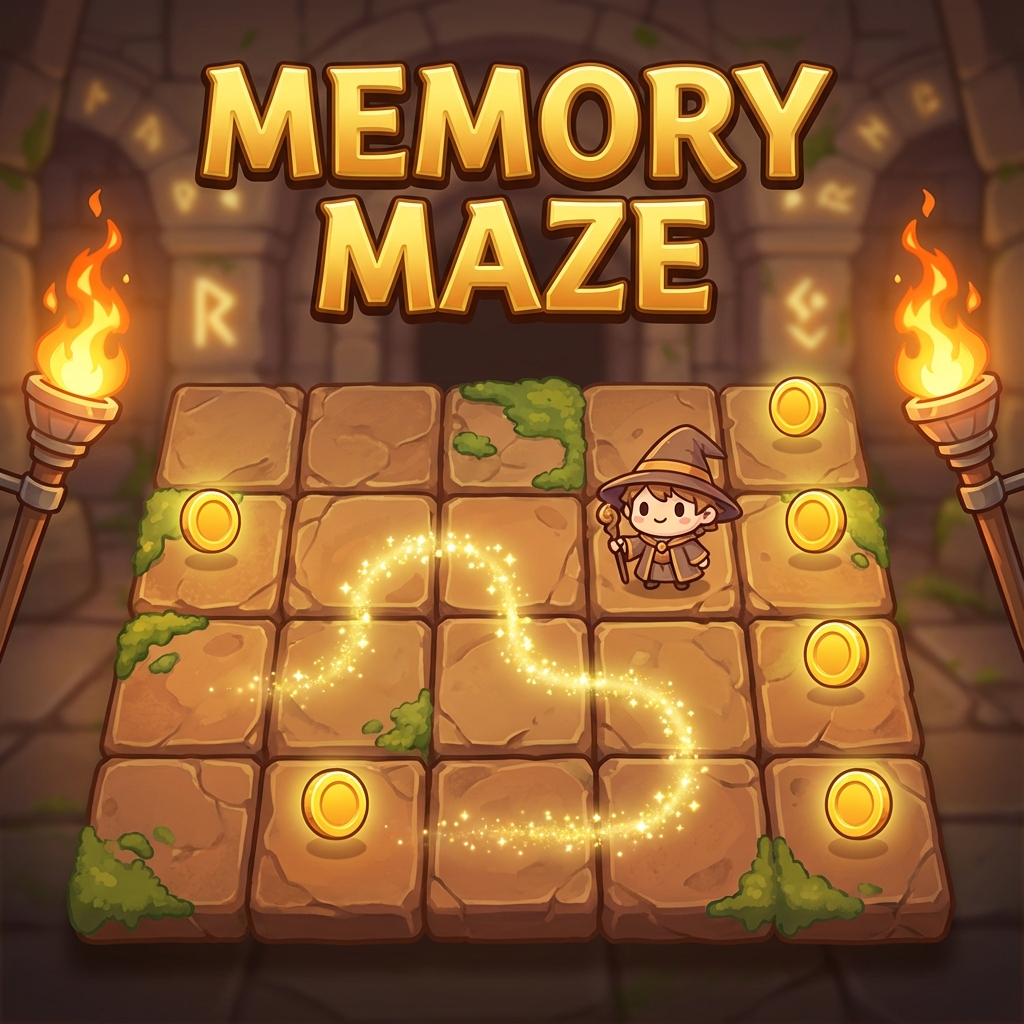

🧠 Deep Dive: Memory Training
The Vital Role of Memory in Early Childhood Development
Working memory is often described as the brain's "scratchpad" or temporary workspace. It is the cognitive system responsible for holding and manipulating information over short periods. For children, a robust working memory is not just a neat party trick—it is the foundational bedrock upon which almost all academic learning is built. Whether a child is sounding out a new word, following multi-step directions from a teacher, or solving a two-digit math problem, their working memory is the engine driving the process.
When educational professionals talk about "brain training," they are frequently referring to exercises designed to stretch and strengthen this exact faculty. Unlike long-term memory (which stores your childhood address or the lyrics to your favorite song), working memory acts as the active processing center. Studies have consistently shown that working memory capacity in childhood is one of the strongest predictors of subsequent academic success—often correlating more closely with reading and math outcomes than standard IQ scores.
Why Digital Games are the Ultimate Memory Gym
Historically, memory training involved flashcards, rote repetition, and physical grouping games (like "I went to the store and I bought..."). While these physical methods remain valuable, digital environments offer a uniquely potent "gym" for cognitive tracking.
Here is why well-designed digital games excel at memory training:
-
Adaptive Difficulty Scaling: The cardinal rule of memory training is the "Goldilocks principle." If a task is too easy, the brain goes on autopilot and no growth occurs. If it is too hard, the child becomes frustrated, stress hormones spike, and the learning center shuts down. Digital games can algorithmically adjust the difficulty second-by-second. If a student breezes through a sequence of 4 items, the game seamlessly introduces 5.
-
Immediate, Low-Stakes Feedback: Traditional learning environments often associate failure with negative emotions (bad grades, teacher correction). Games recontextualize failure as part of the fun. A missed match in a memory card game simply flips the cards back over with a playful boop, encouraging another try without the sting of academic failure.
-
Multisensory Encoding: The best digital memory games do not rely solely on visuals. By tying an auditory tone, a physical haptic rumble (on tablets), and a visual shape together, games encourage "multisensory encoding." This creates multiple neural pathways to the same piece of information, making it significantly easier for the child's brain to retrieve it later.
Types of Memory Training Through Play
When engaging with the Memory skills lab, children are navigating several distinct types of memory retention:
1. Visual-Spatial Memory
This involves remembering where things are and what they look like. Think of classic "Concentration" or "Pairs" games. A child must remember that the image of the Apple is in the top-left corner, while searching for its match. Real-world application: Visual-spatial memory translates directly to reading skills (recognizing letter shapes and their orientation, like 'b' vs 'd') and geometry.
2. Sequential Memory
Sequential memory tasks ask children to remember the order of events. A game might flash colors in a specific pattern (Red, Blue, Green, Red) and ask the child to reproduce it. Real-world application: This is the exact cognitive muscle used for spelling (remembering the order of letters in a word) and following multi-step instructions ("Put your shoes away, wash your hands, and come to the table").
3. Working Memory Updating
More advanced games require children to hold information in their minds while simultaneously processing new information. For example, a game might ask a child to remember a sequence of numbers, but then interrupt them with a quick mini-challenge before asking for the numbers back. Real-world application: This mimics the complex environment of a modern classroom, where a student must hold the teacher’s instruction in mind while searching their desk for a pencil.
Tips for Parents and Educators
While digital games are powerful tools, their efficacy skyrockets when paired with adult interaction. To get the maximum educational value from these games, try the following techniques:
- Teach "Chunking": If a child is struggling to remember a sequence of 6 items, teach them to group them into two sets of 3. (Instead of remembering 4-1-9-8-2-5, remember 419... 825). This is a meta-cognitive strategy they will use for the rest of their lives.
- Encourage Vocalization: Have the child say the items out loud as they appear on the screen. Translating a visual symbol into an auditory word utilizes a separate part of the brain and drastically improves retention.
- Limit Session Length: Cognitive fatigue is real. The brain is quite literally burning glucose during intense memory tasks. Keep sessions to 10-15 minutes of high-focus play, rather than hour-long marathons, to prevent burnout and maximize structural brain changes.
Conclusion
Memory is not a fixed, innate trait; it is a highly malleable skill that can be developed with targeted, playful practice. By engaging with the carefully curated challenges in our Memory lab, children are not just matching cards or repeating sequences—they are actively wiring their brains for a lifetime of efficient, stress-free learning.