The Neurobiology of Play: Why the Brain Learns Better Through Games
1. The "Dopamine Advantage" in Cognition
When a student plays a game like Language Arts Master, their brain isn't just "having fun"—it is undergoing a biochemical transformation. Dopamine, often misunderstood as a "pleasure molecule," is actually a "prediction error" molecule. It is released when the brain anticipates a reward or solves a challenge.
Long-Term Potentiation (LTP)
In educational gaming, this dopamine release strengthens the synaptic connections between neurons, a process called Long-Term Potentiation. This is the physical basis of learning. Information learned during a high-engagement game is significantly more likely to be moved from short-term "working memory" to long-term storage.
2. Self-Determination Theory (SDT) in the Classroom
Why do students resist worksheets but embrace the exact same math in a game? The answer lies in Self-Determination Theory (Deci & Ryan, 1985), which identifies three universal human needs:
- Autonomy: The power to make choices (Which level do I play first?).
- Competence: The feeling of getting better (Leveling up).
- Relatedness: Connecting with others (Sharing a high score).
Games satisfy these needs perfectly, transforming "external" pressure (the teacher's grade) into "intrinsic" motivation (the desire to win).
3. The "Flow State" Architecture
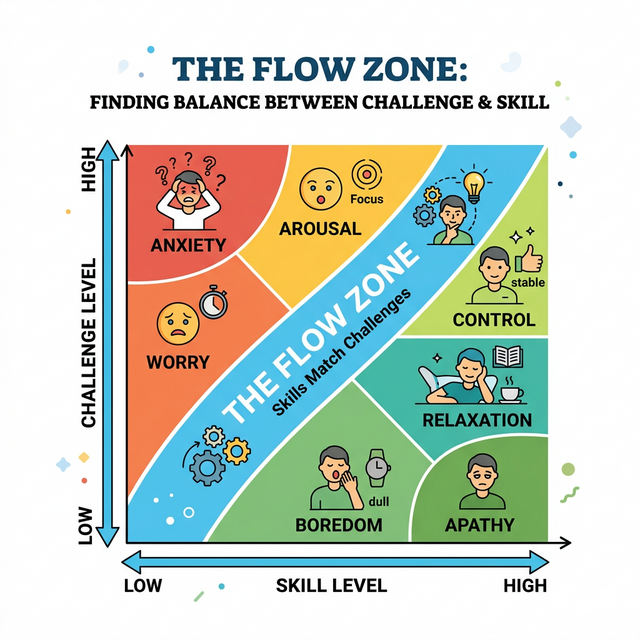
Mihaly Csikszentmihalyi’s concept of "Flow" describes a state of total immersion where the challenge of a task perfectly matches the skill level of the user.
The Flow Balance:
- Too Easy: Boredom (The student shuts down).
- Too Hard: Anxiety (The student quits).
- The Sweet Spot: Flow (Optimal Learning).
OMG.LAND games use adaptive difficulty curves to keep students in this "Goldilocks Zone" for as long as possible.
4. The Power of "Safe Failure"
In a traditional test, failure is permanent and punitive. In a game, failure is an "Information Event."
- Rapid Iteration: A student can lose a level and restart in 2 seconds.
- Real-Time Feedback: They know exactly why they lost (e.g., "I clicked 15 instead of 16"). This rapid error-correction cycle is the fastest way the human brain acquires complex skills.
5. Cognitive Load Theory (CLT)
By using "Gamified Overlays," we can manage a student's Cognitive Load.
- Intrinsic Load: The difficulty of the math itself.
- Extraneous Load: The "boring" parts of the lesson (instructions).
- Germane Load: The mental effort put into building new schemas. Games reduce extraneous load by making instructions intuitive, allowing more "brain power" to be spent on the actual subject matter.
6. Practical Application for Educators
- The "Game-Based Start": Use a 5-minute game to "prime" the brain with dopamine before a heavy lecture.
- The "Reward-Based Finish": Use a game to test consolidation. If they can solve the math in the "Boss Fight," they have mastered the concept.
- Data-Driven Insight: Observe where students fail in the game. That is their specific area of conceptual weakness.
7. Academic References & Further Reading
- Kapp, K. M. (2012). The Gamification of Learning and Instruction.
- McGonigal, J. (2011). Reality is Broken: Why Games Make Us Better and How They Can Change the World.
- Whitton, N. (2014). Digital Games and Learning: Research and Theory.
Explore more research in our Teacher Insights Portal.
This resource is designed to support high-quality educational engagement. For more safe gaming resources, explore our Guides section.